直击考场 | 8月8日雅思考试回忆
2026-08-17 10:24:02
浏览:
来源:新航道官网
本周听力考试题型较为常规,涵盖了填空、单选和配对题。Part 1 为填空题型,考查投诉订货物流问题下的基础信息捕捉与拼写能力;Part 2 为单选与地图题型,围绕水族馆参观话题,重点考察细节理解与同义替换能力;Part 3 为单选与配对题型,话题饮食类研究的presentation讨论,语言难度较高,需要同学们在多人对话中准确区分不同发言者的观点与细节;Part 4 为学术讲座填空题型,围绕考古挖掘相关话题,考查学术场景下的细节捕捉与词汇拼写能力。
Part 1 投诉订货场景(Incident Report)
【题型】:填空
本部分为常规填空题型,场景为投诉订货(incident report),属于雅思听力Part 1 的高频话题。答案词整体难度适中,但需注意以下几点:① 5-10题物品类细节被大量形容词修饰,需注意辨析主要名词;② 数字表达注意double+数字;③ 拼写难度不高但需避免粗心失误。总体而言,本部分要求同学们对编码、数字串的反应速度,以及在日常对话场景中快速捕捉关键细节的能力。原题为九分达人5 test 3 part 1.
Complete the notes below. Write NO MORE THAN TWO WORDS for each answer.
1. Telephone number: __________
2. Date of arrival:__________.
4. The total value of insurance: __________
5. Furniture and __________.
6. a rocking horse, some________ and fruit bowls.
8. the __________needs to be replaced .
9. a __________of one of the dining chairs is split .
10. four_______ were broken.
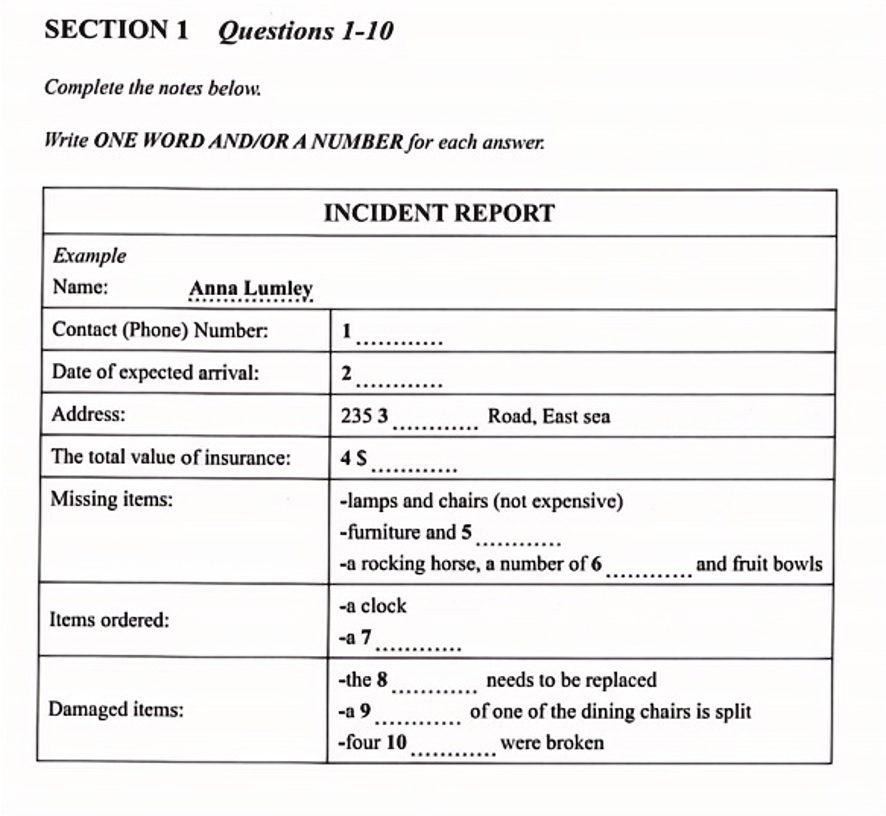
(答案仅供参考,实际答案与顺序可能有变化)
Part 2 水族馆(aquarium)
【题型】:单选+地图
本部分围绕水族馆(Aquarium)话题展开,采用单选题与地图题的组合形式。单选题(11-15题)涉及地点位置,花费,导览讨论等内容,信息点较为密集,需要同学们快速抓取关键细节并进行同义替换判断。地图题(16-20题)要求根据地图信息,听音识别位置与动线表达,考察同学们的听音识图能力。建议同学们在备考中积累常见的位置关系,游览类话题词汇,并加强匹配题中干扰项排除的训练。
11.where is the aquarium located
12. what costs the aquarium most money
13. what is recommended for small children
14. the guide recommends the should
15. what attraction can visitors see from a
(答案仅供参考,实际答案与顺序可能有变化)
Part 3 盐与健康的研究(presentation on salt in the diet)
【题型】:单选+匹配
本部分围绕"盐的研究"展开学术讨论,采用单选题与配对题的组合形式。单选题(21-25题)涉及双方观点讨论,盐的研究报告,过去的研究分析等多个角度,信息密度高,需要同学们在Jane 和 Peter 的对话中准确区分各自观点并注意同义替换。配对题(26-30题)要求将Peter和Jane针对presentation的不同部分的评价进行匹配,考查学生对presentation结构的细节与评价的理解和信息归纳能力。建议同学们在考前多复习presentation的结构与相关讨论场景词汇,积累相关语料,并加强在多人学术对话中追踪不同发言者立场的专项训练。
21.What is Jane's initial attitude towards the topic of their presentation
答案:C. she believes it may be too similar to another topic.
22. what point does Peter make about Lewis Dhal’s research with rats and salt intake?
答案:A. Dahl gave rats an unusually high amount of salt.
23. what does Jane suggest about Dahl’s research into salt consumption in Japan?
答案:B. it was limited in scope.
24. Peter argues that the figures of the 2010 study on reducing salt intake,
答案:A. are just estimates (speculations).
25. Proposals for clinical trails have been rejected by the US government because of
匹配题(26-30)
What comment is made about each of the following sections of the presentation?
|
题号
|
答案
|
comment
|
|
26
|
C
|
Should involve audience participation (应该包含观众参与)
|
|
27
|
B
|
May contain factual errors
(可能包含事实错误)
|
|
28
|
F
|
Needs some additional verbal input
(需要一些额外的口头说明)
|
|
29
|
H
|
Must include Jane and Peter’s opinions
(必须包含Jane和Peter的观点)
|
|
30
|
D
|
Could have visual representation (可以采用视觉呈现)
|
Part 4 鲁氏登堡垒考古挖掘(Fort Rushtown Archaeological Excavation)
【题型】:填空
本部分为雅思听力Part 4 的学术讲座填空题型,话题围绕考古研究(archaeological)展开讨论。Part 4 是听力部分中难度的环节,要求学生在连续的学术独白中准确捕捉关键信息词并进行拼写。本次考查的答案词涵盖了考古,历史,建筑与常见材料等多个维度,词汇类型丰富,既包含常见词汇也涉及学术场景高频词。建议同学们在备考中重点积累考古类,常见建筑类与建筑材料相关话题词汇,同时加强学术讲座类听力材料的精听训练,对长段落中关键信息的定位与速记能力。
Complete the notes below. Write ONE WORD ONLY for each answer.
(答案仅供参考,实际答案及顺序可能有变化)
整体评价:本场考试话题涵盖东南亚传统文化、环境心理学与教育语言学,难度中等。本次考试三篇文章主题鲜明,难度梯度合理。P1的文化艺术类话题相对友好,是基础分的;P2的段落信息匹配考验考生的快速阅读和信息筛选能力;P3的选择题和判断题则考验对复杂学术论点的理解和辨析能力。建议在后续备考中,加强对学术议论文的精读训练,熟悉常见的论证逻辑(如引用、对比、因果),并积累教育学、语言学领域的核心词汇。
逻辑关系:P1侧重于工艺流程的描述与文化差异的对比(泰国vs. 马来西亚vs. 印度尼西亚);P2侧重于理念阐释与应用案例,包含举例论证(樟宜机场、垂直森林);P3侧重于观点论证与反驳,包含引用论证(Goethe、Cummins)和因果论证(母语发展→第二语言发展)。
核心话题词:
传统艺术(shadow puppetry, hide, chisel, rod, improvisation)
环境设计(biophilic design, nature, well-being, productivity, sustainability)
教育语言学(mother tongue, bilingual, literacy, transfer, mainstream language, identity)
Passage 1 Shadow Puppets in Southeast Asia 东南亚皮影戏
【难度】:三颗星
【题型】:判断5+填空8
【类别】:文化艺术/传统戏剧
概述:本文介绍了东南亚皮影戏这一古老戏剧形式。从制作工艺(兽皮处理、打孔雕刻、染色、装操纵杆)到表演特色(视觉象征、即兴发挥),再到各地的文化差异(泰国、马来西亚、印度尼西亚的不同传统),全面展现了皮影戏在东南亚地区的艺术价值与文化意义。
填空题:利用专有名词(Thailand, Malaysia, Indonesia)和主题词(hide, chisels, rods, screen)定位。答案均为单个名词,注意拼写和单复数。
判断题:重点关注事实细节(如皮影的制作步骤、表演特点)与原文信息之间的对应关系。
Passage 2 Biophilic Design 亲自然设计
【难度】: 三颗星
【题型】:段落信息匹配(5题)+ 特殊词匹配(3题)+ 填空题(4题)
【类别】:环境设计+心理学
概述:本文探讨了"亲自然设计"(Biophilic Design)理念——即在建筑和城市设计中融入自然元素,以满足人类与生俱来的与自然联结的需求。文章介绍了该理念的科学依据、在不同项目中的应用案例(如新加坡樟宜机场、米兰垂直森林)、以及其对居民健康和幸福感的积极影响。
段落信息匹配:作为第一组题,建议先做,以快速熟悉文章结构。阅读每个题干,提取独特性关键词(如"a particular kind of material"、"health benefits"),然后扫读各段首尾句,锁定目标段落。
特殊词匹配:人名或机构名称较多,建议在阅读过程中,用笔在文中圈出所有人名/机构名,并在旁边简要标注其核心观点或研究发现。做题时,将题干描述与笔记进行同义替换匹配。注意本题有复选。
填空题:位于文章末尾,是对文章核心概念和应用效果的总结。先通读摘要,理解其逻辑脉络,再根据关键词定位回原文填写。
Passage 3 The Significant Role of Mother Tongue in Education 母语在教育中的重要作用
【难度】:四颗星
【题型】:判断题5+选择题9
【类别】:教育学/语言习得
参考文章 READING PASSAGE 3
The Significant Role of Mother Tongue in Education
One consequence of population mobility is an increasing diversity within schools. To illustrate, in the city of Toronto in Canada, 58% of kindergarten pupils come from homes where English is not the usual language of communication. Schools in Europe and North America have experienced this diversity for years, and educational policies and practices vary widely between countries and even within countries. Some political parties and groups search for ways to solve the problem of diverse communities and their integration in schools and society. However, they see few positive consequences for the host society and worry that this diversity threatens the identity of the host society. Consequently, they promote unfortunate educational policies that will make the “problem” disappear. If students retain their culture and language, they are viewed as less capable of identifying with the mainstream culture and learning the mainstream language of the society.
The challenge for educator and policy-makers is to shape the evolution of national identity in such a way that rights of all citizens (including school children) are respected, and the cultural linguistic, and economic resources of the nation are maximised. To waste the resources of the nation by discouraging children from developing their mother tongues is quite simply unintelligent from the point of view of national self-interest. A first step in providing an appropriate education for culturally and linguistically diverse children is to examine what the existing research says about the role of children’s mother tongues in their educational development.
In fact, the research is very clear. When children continue to develop their abilities in two or more languages throughout their primary school, they gain a deeper understanding of language and how to use it effectively. They have more practice in processing language, especially when they develop literacy in both. More than 150 research studies conducted during the past 25 years strongly support what Goethe, the famous eighteenth-century German philosopher, once said: the person who knows only one language dose not truly know that language. Research suggests that bilingual children may also develop more flexibility in their thinking as a result of processing information through two different languages.
The level of development of children’s mother tongue is a strong predictor of their second language development. Children who come to school with a solid foundation in their mother tongue develop stronger literacy abilities in the school language. When parents and other caregivers (e.g. grandparents) are able to spend time with their children and tell stories or discuss issues with them in a way that develops their mother tongue, children come to school well-prepared to learn the school language and succeed educationally. Children’s knowledge and skills transfer across languages from the mother tongue to the school language. Transfer across languages can be two-way: both languages nurture each other when the educational environment permits children access to both languages.
Some educators and parents are suspicious of mother tongue-based teaching programs because they worry that they take time away from the majority language. For example, in a bilingual program when 50% of the time is spent teaching through children’s home language and 50% through the majority language, surely children won’t progress as far in the latter? One of the most strongly established findings of educational research, however, is that well-implemented bilingual programs can promote literacy and subject-matter knowledge in a minority language without any negative effects on children’s development in the majority language. Within Europe, the Foyer program in Belgium, which develops children’s speaking and literacy abilities in three languages (their mother tongue, Dutch and French), most clearly illustrates the benefits of bilingual and trilingual education (see Cummins, 2000).
It is easy to understand how this happens. When children are learning through a minority language, they are learning concepts and intellectual skills too. Pupils who know how to tell the time in their mother tongue understand the concept of telling time. In order to tell time in the majority language, they do not need to re-learn the concept. Similarly, at more advanced stages, there, is transfer across languages in other skills such as knowing how to distinguish the main idea from the supporting details of a written passage or story, and distinguishing fact from opinion. Studies of secondary school pupils are providing interesting findings in this area, and it would be worth extending this research.
Many people marvel at how quickly bilingual children seem to “pick up” conversational skills in the majority language at school (although it takes much longer for them to catch up with native speakers in academic language skills). However, educators are often much less aware of how quickly children can lose their ability to use their mother tongue, even in the home context. The extent and rapidity of language loss will vary according to the concentration of families from a particular linguistic group in the neighborhood. Where the mother tongue is used extensively in the community, then language loss among young children will be less. However, where language communities are not concentrated in particular neighborhoods, children can lose their ability to communicate in their mother tongue within 2-3 years of starting school. They may retain receptive skills in the language but they will use the majority language, in speaking with their peers and siblings and in responding to their parents. By the time children become adolescents, the linguistic division between parents and children has become an emotional chasm. Pupils frequently become alienated from the cultures of both home and school with predictable results.
Choose the correct letter, A, B, C or D. Write the correct letter in boxes 27-30 on your answer sheet.
27. What point did the writer make in the second paragraph?
A Some present studies on children’s mother tongues are misleading/
B A culturally rich education programme benefits some children more than others.
C Bilingual children can make a valuable contribution to the wealth of a country.
D The law on mother tongue use at school should be strengthened
28. Why does the writer refer to something that Goethe said?
A to lend weight to his argument
B to contradict some research
C to introduce a new concept
D to update current thinking
29. The writer believes that when young children have a firm grasp of their mother tongue
A they can teach older family members what they learnt at school
B they go on to do much better throughout their time at school.
C they can read stories about their cultural background.
b they develop stronger relationships with their family than with their peers
30. Why are some people suspicious about mother tongue-based teaching programmes?
A They worry that children will be slow to learn to read in either language.
B They think that children will confuse words in the two languages.
C They believe that the programmes will make children less interested in their lessons.
D They fear that the programmes will use up valuable time in the school day.
Complete the summary using the list of word, A-J, below
It was often recorded that bilingual children acquire the (31)…………………to converse in the majority language remarkable quickly. The fact that the mother tongue can disappear at a similar (32)……………..is less well understood. This phenomenon depends, to a certain extent, on the proposition of people with the same linguistic background that have settled in a particular (33)………………If this is limited, children are likely to lose the active use of their mother tongue. And thus no longer employ it even with (34)………………….., although they may still understand it. It follows that teenager children in these circumstances experience a sense of (35)………………….in relation to all aspects of their lives.
Do the following statements agree with the information given in Reading Passage 3? In boxes 36-40 on your answer sheet, write
YES if the statement agrees with the views of the writer
NO if the statement contradicts the views of the writer
NOT GIVEN if it is impossible to say what the writer thinks about this
36.Less than half of the children who attend kindergarten in Toronto have English as their mother tongue.
37.Research proves that learning the host country language at school can have an adverse effect on a child’s mother tongue.
38.The Foyer program is accepted by the French education system.
39.Bilingual children are taught to tell the time earlier than monolingual children.
40.Bilingual children can apply reading comprehension strategies acquired in one language when reading in the other.
(答案仅供参考,实际答案及顺序可能有变化)
概述:本文论证了母语在儿童教育中的关键作用。作者指出,支持母语发展的双语教育不仅不会阻碍主流语言的学习,反而能促进儿童的认知发展和学业成就。文章引用了大量研究证据,驳斥了"母语教学占用主流语言学习时间"的误解,并警告了母语流失对亲子关系和儿童身份认同造成的负面影响。
单选题:通常考察段落主旨或人物观点,需要综合理解上下文,而非依赖单一细节。注意排除含有化表述或与原文明显矛盾的选项。
判断题:重点关注作者观点与题干表述之间的对应关系。注意题干中的程度副词(如"less than half"、"earlier than")往往是判断关键。
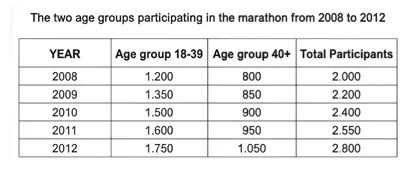
The table shows the two age group participating in the marathon from 2008 to 2012. Summarise the information by selecting and reporting the main features, and make comparisons where relevant.
点评
动态表格题,两个年龄组在五年内参加马拉松的人数数据,全程单一上升趋势,属于小作文里比较友好的一类,但看重对于数据的比较。
(1)表格里1.200等数据是千分位符,不是小数。
(2)数据只有上升,没有多余转折点,所以重点放在抓"涨幅的大小"和比较"两组差距变化",避免流水账式的写法。
② 18-39岁组始终占主导,且与40+组的gap逐年扩大。
讲总数和两组各自的上升:总人数从2000涨到2800;18-39组从1200涨到1750,40+组从800涨到1050。把"都在涨"这件事用首尾数字带一下。
讲两组之间的关系:18-39组每年都比40+组多,占比一直在总人数的60%左右。
而且差距在拉大,从2008年的400人差距拉到2012年的700人差距。
Task 2:
Some people think that governments should focus on developing the economy. Others believe that protecting the natural environment is more important. Discuss both views and give your own opinion.
点评
Discuss both views and give your opinion,双边讨论型。题目给出两种观点,考生需分别论证两方观点的合理性,并在结尾明确表明个人立场。
题眼在于"government should focus on",讨论应围绕政府的政策应优先于谁展开,不要只着重于论述经济或环境本身的重要性。此外,结尾不要模棱两可,即便最终立场是"两者兼顾但有所侧重",也需明确表达倾向。
Introduction:改写题目,表明个人观点。
Conclusion:与开头段中的立场一致,简要说明理由,并可补充说明经济与环境并非完全对立,理想状态是实现协调发展。(补充说明一定要放在明确表态之后,作为延伸观点,否则会像墙头草,立场不够鲜明)
-经济增长能创造大量就业(job creation),直接民众生活水平(improve living standards)。
-只有经济实力增强,国家才有更多资源投入公共服务,比如医疗和教育(fund public services)。
-发展中国家往往面临贫困问题,经济增长是脱贫的前提(lift people out of poverty)。
-一个国家的综合国力(national strength)和国际竞争力也依赖经济基础。
-环境破坏很多是不可逆的(irreversible damage),被破坏后再去挽回是不理智的。
-污染治理的成本远高于预防成本。(the cost of cleaning up pollution outweighs the cost of prevention)
-气候变化(climate change)带来的极端天气、海平面上升(rising sea levels)等问题会反过来威胁经济发展本身。
-环境污染会影响公众健康(public health),间接增加社会医疗负担,这本身也是一种经济损失。
*补充一点思路:这两个观点其实不是完全对立的,我们可以强调"环境是经济可持续发展的基础"(environment as the foundation for sustainable economic growth)这个角度,把两者关联起来,而不是非此即彼地选边站,这样的论证会更有层次。
新航道全国报名咨询热线:400-011-8885。如需了解雅思、托福、SAT、A-Level、GRE、多邻国等语言培训课程,或咨询出国留学规划、院校申请、试听课预约等服务,欢迎致电咨询。专业顾问将为您提供一对一答疑。