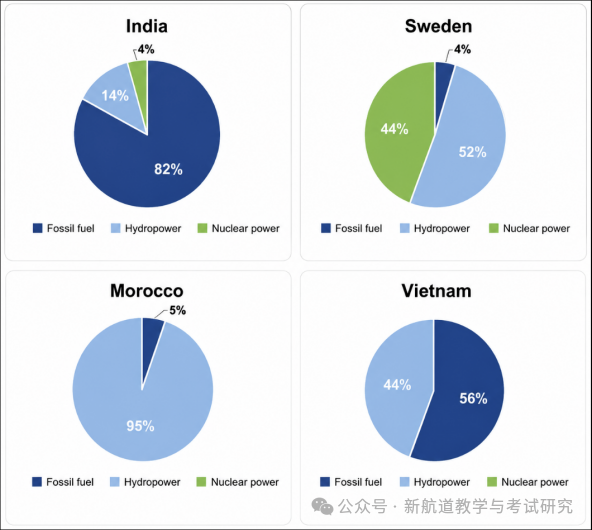
The charts show the sources of the electricity produced in four countries in 2008.
主体分段方法:按照<国家>分段
主体1:India、Vietnam(化石燃料占主导)
主体2:Sweden、Morocco(水里发电占主导)
开头段
The pie charts compare the proportions of electricity generated from fossil fuels, hydropower and nuclear power in India, Sweden, Morocco and Vietnam in 2008.
概述段
Overall, India and Vietnam derived most of their electricity from fossil fuels, whilehydropower was the primary source in the other two countries. Nuclear power, by contrast, played only a minor role in all countries except Sweden.
思路要点:
- India、Vietnam的化石燃料发电占比重,Sweden、Morocco的水力发电占比重
- 除Sweden外大多数国家核能发电占比都极低
Body paragraph 1
Among the two countries that relied primarily on fossil fuels, India recorded the highest proportion, with fossil fuels accounting for 82% of electricity generation,significantly higher than56% in Vietnam. In comparison, hydropower represented44% of its electricity production in Vietnam, compared withonly 14% in India. Nuclear energy constitutedthe remaining 4% in India, whileVietnam generated no electricity from this source.
思路要点:India、Vietnam
- India、Vietnam中化石燃料占比都,在India占比82%,远高于Vietnam的56%
- Vietnam的水力发电相对较高(44%),India水力发电仅为14%
- India的核能发电占比4%,Vietnam不使用核能发电
Body paragraph 2
In the remaining hydropower-dominated countries, Morocco generated the vast majority of its electricity from hydropower (95%), leaving fossil fuels to account for just 5%. Sweden exhibited a similar pattern, with hydropower representing52% of its electricity generation, followed by nuclear power (44%). Fossil fuel was also the least common source, making up4% of the total energy supply.
思路要点:Morocco,Sweden
- Morocco和Sweden中都是水力发电占比
- Morocco:水力发电占绝大部分(95%),但化石燃料发电占比仅为5%
- Sweden:呈现类似规律,hydro power占比(52%),核能排第二(44%);化石燃料占比,仅为4%